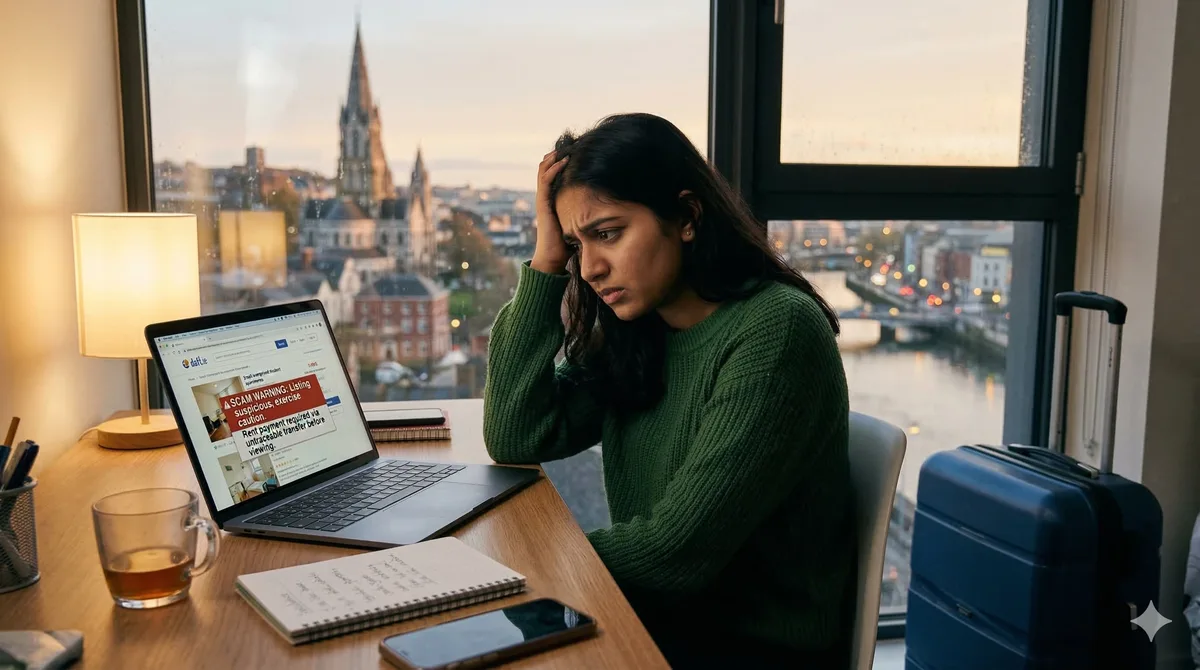
Finding accommodation is one of the first challenges for those arriving in Ireland to study or work. In cities with a large presence of international students, such as Cork, Dublin, and Galway, the high demand for rooms and apartments creates a scenario that unfortunately also attracts scammers.
In recent years, consumer protection authorities and organizations in Ireland have frequently warned about rental-related frauds, especially those targeting students and international exchange students. These scams often occur precisely in the months when many students are arriving in the country to start courses or exchange programs.
With the pressure to find accommodation quickly and the lack of familiarity with the local real estate market, many newcomers become easy targets for criminals.
How Accommodation Scams Work
The most common scam occurs when someone advertises a property or room that does not exist or is not actually available for rent. The scammer uses real photos of properties, often taken from legitimate ads or short-term rental platforms.
After the victim shows interest, the supposed owner requests a deposit or the first month's rent to "secure" the property. After payment, the scammer disappears, and the person discovers that the property was never available for rent.
Another scam involves properties that actually exist. In some cases, criminals use photos and information from legitimate ads but change the owner's contact information to direct victims to them.
There are also reports of victims who arrive at the property on the agreed-upon day to receive the keys and discover that several other people have also paid for the same place, realizing only then that it was a scam.
The Airbnb and Fake Subletting Scam
A type of fraud that has been increasingly reported involves properties temporarily rented on platforms like Airbnb.
In this scheme, the scammer rents a property for a few days, usually through legitimate accommodation platforms. During this period, they post ads offering the property as if it were a long-term rental.
When an exchange student shows interest, the scammer schedules a visit to the location. Since the property actually exists and is temporarily under the criminal's control, the visit seems completely legitimate.
After the visit, the victim pays the security deposit and the first rent. When the moving day arrives, they discover that the property was only a temporary rental and that the real owner has no relation to the contract made by the scammer.
Similar cases have been reported in forums and communities of residents in Ireland, including properties in Cork and Dublin.
Why Exchange Students Are the Main Targets
International students are particularly vulnerable to this type of fraud for several reasons.
Many are arriving in the country for the first time and do not know how the local rental market works. Additionally, the language barrier can make it difficult to interpret suspicious ads or contracts.
Organizations that support international students also highlight that a large part of the search for accommodation happens in social media groups and messaging chats, environments where scams are more common.
Another important factor is the pressure to find accommodation quickly, especially at the beginning of the academic year. This sense of urgency leads some people to make decisions without verifying all the necessary information.
Warning Signs That May Indicate a Scam
There are some common signs that can help identify potential scams during the search for accommodation in Ireland.
One of the main alerts is when the rental price seems much lower than the average value in the region. Scammers often use low prices to attract interest quickly.
Another common sign is when the supposed owner claims to be out of the country and cannot show the property in person. In many cases, they say they will send the keys by mail after the deposit payment.
It is also important to be cautious when someone asks for immediate payment to "reserve" the property, especially before any contract or visit to the location.
Consumer protection authorities recommend always being suspicious when there is pressure to transfer money quickly or when the ad contains vague or inconsistent information.
How to Avoid Falling for Accommodation Scams
There are some simple measures that can help reduce the risk of fraud.
Whenever possible, visit the property in person before making any payment. Checking the property in person helps confirm that it exists and is available.
It is also recommended to research the owner's or real estate agency's name online and verify if the company actually exists.
In Ireland, many rented properties need to be registered with the Residential Tenancies Board, the body responsible for regulating the rental sector in the country.
Another important recommendation is to avoid cash payments or transfers that cannot be traced. Using recorded payment methods increases the chances of recovering the money if something goes wrong.
Keeping all conversations, emails, and payment receipts can also be essential in case it is necessary to report the fraud to the authorities.
Information Is the Best Protection
Accommodation scams unfortunately exist in many countries, and Ireland is no exception. The combination of high demand for accommodation and a large number of international students creates an environment where criminals try to take advantage of those arriving.
Therefore, seeking reliable information before searching for accommodation can make all the difference in avoiding financial losses and frustrations at the beginning of the experience in the country.
The Irish Compass was created to help exchange students and new residents understand how different aspects of life in Ireland work, from accommodation and transportation to documentation and job opportunities.
If you are planning to come to Ireland or are already in Cork and want to understand how to find accommodation more safely, you can talk to the Irish Compass's intelligent assistant on WhatsApp and receive practical guidance to navigate the first steps of your journey in the country with more confidence.
---
Sources
Competition and Consumer Protection Commission (CCPC)
Ireland's official consumer protection authority. Published specific guidelines warning students and exchange students about accommodation scams, including recommendations to avoid rental frauds.
Irish Examiner – Students warned about accommodation scams
Report covering the increase in rental scams in Ireland and warning international students about frauds involving security deposits and fake property ads.
Irish Examiner – Rental scam warnings and fraud cases
Article reporting recent cases of rental frauds and explaining how criminals use fake ads or real properties to deceive students looking for accommodation.
RTÉ News – Rent fraud cases reported in Ireland
Coverage by Ireland's main public news channel about victims of rental scams who paid deposits and discovered the fraud only when they were supposed to receive the property keys.
Irish Council for International Students (ICOS)
Organization supporting international students in Ireland, warning about student accommodation frauds and recommending verification of ads and caution before making payments.
The Irish Times – Warning about rental scams targeting students
Article highlighting the growth of accommodation scams in Ireland and warning students looking for accommodation during periods of high demand for rentals.