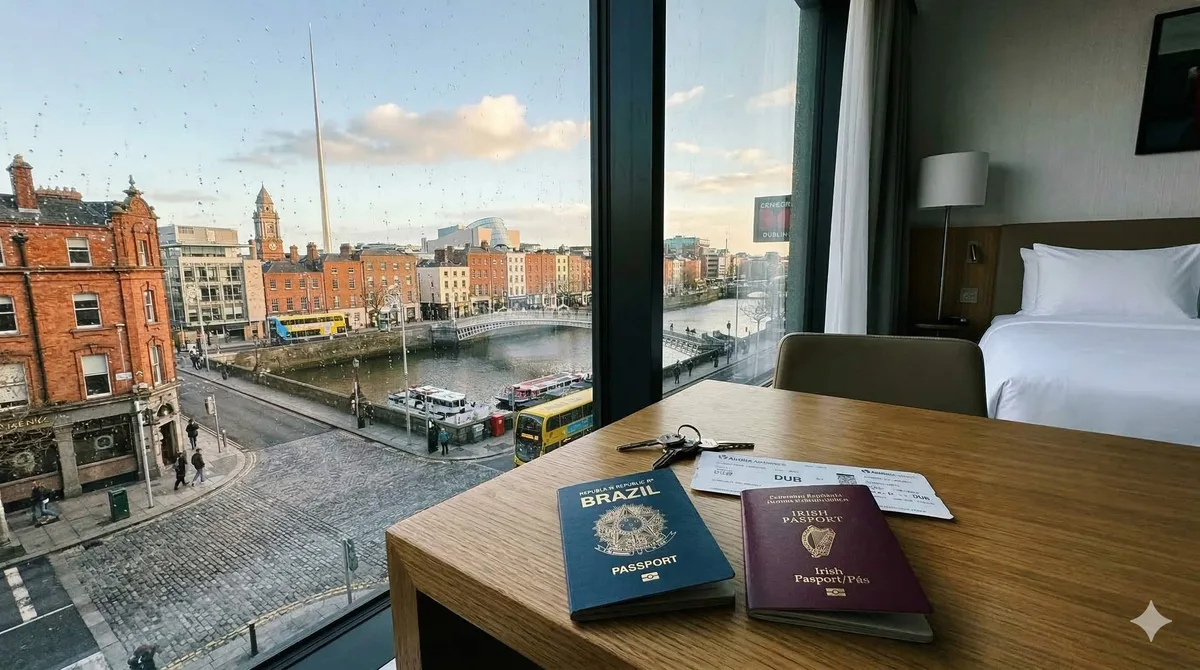
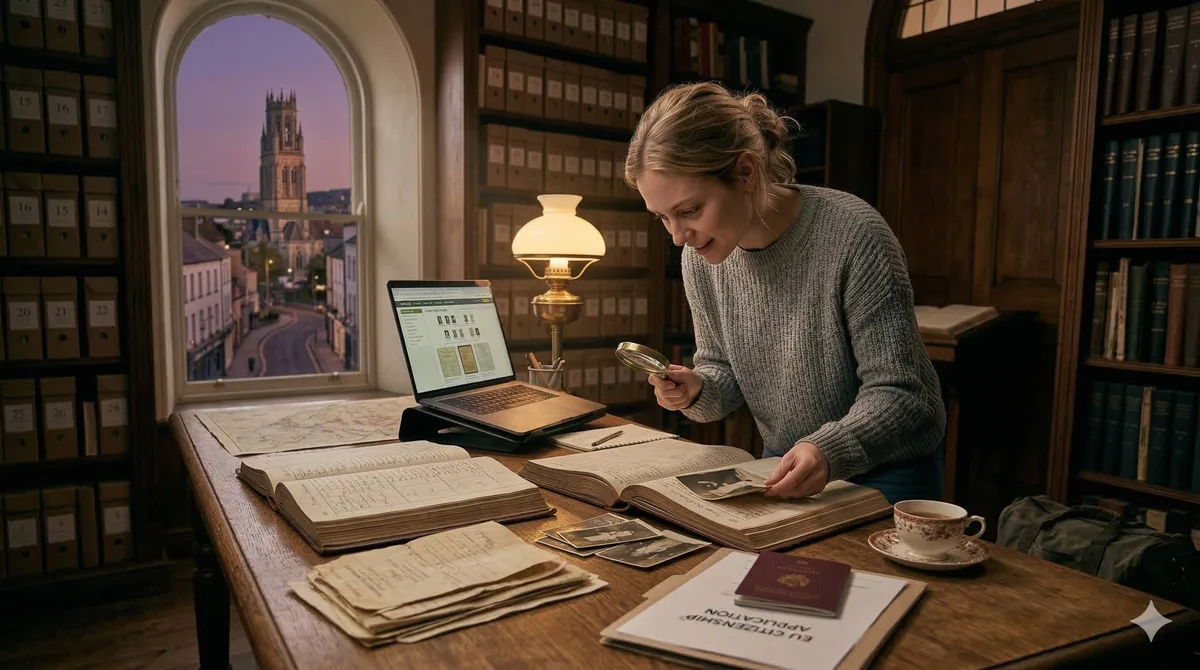
Many Brazilians arrive in Ireland completely focused on their exchange program, improving their English, working, living an international experience, and building a new stage of life. At first, this seems enough. The routine revolves around school, job hunting, adapting to the climate, accommodation, and all the discoveries that come with living in another country. However, as the months pass, many people begin to realize that there's a significant difference between being in Europe as an exchange student and being in Europe as a European citizen.
This awakening usually happens in practice. Sometimes it arises during a job application, when certain positions offer better conditions for those who already have European citizenship. In other cases, it appears when the person thinks about the long term and realizes that having citizenship can represent more freedom to live, work, and travel across different countries on the continent with many fewer barriers. What once seemed like a distant issue begins to gain more weight, especially when the exchange student understands that there might be a real possibility within their own family.
European citizenship starts to be seen not just as a document, but as a life asset. It can broaden professional horizons, facilitate medium and long-term decisions, and provide more security for those who want to build an international career in a more structured way. For many exchange students, this topic stops being a curiosity and becomes an important project.
Why European citizenship gains so much importance during the exchange program
While the idea of citizenship is still in Brazil, it often seems abstract. Many people grew up hearing that they had an Italian grandfather, a Portuguese great-grandfather, or some European ancestor, but without knowing exactly if that could generate a real right or if the family history had sufficient documentation to prove a line of descent.
When the person arrives in Ireland, this perception changes. This happens because the international experience makes the practical advantages of having a formal link with the European Union more visible. The exchange student starts to observe how certain opportunities are more accessible to those who already possess citizenship, and this naturally raises the question, do I also have this right and never really investigated it?
This point is important because many processes don't move forward not due to a lack of right, but due to a lack of organized information. In numerous families, there exists a solid basis to initiate an analysis, however, the names, dates, cities, registries, and records are scattered in old conversations, incomplete documents, and memories of relatives.
Benefits that make many exchange students rethink this topic
One of the strongest reasons for this interest is the professional impact. Depending on the context, having European citizenship can simplify access to opportunities, expand hiring possibilities, and make some career moves less bureaucratic. For those already living in Ireland, this is often perceived very clearly.
Besides the work aspect, there's also the issue of mobility. The exchange student who is currently in one country may start thinking about studying, working, or living in another European country in the future. With citizenship, this horizon can become much simpler. Life planning changes. The feeling stops being just about enjoying a season abroad and becomes about being able to build more permanent paths, if that makes sense.
There's also an emotional and family factor that weighs heavily. When a person decides to investigate their origin, they're not just looking for a practical benefit. Many times, they're also reconstructing their family's history, understanding where their ancestors came from, what their displacements were, and how these records were scattered across countries, states, cities, churches, and registries. This process often has a value that goes beyond the migratory objective.
The biggest challenge is almost never the desire, but knowing where to start
It's very common for the exchange student to realize the value of European citizenship and get stuck right at the first question, where do I start?
This doubt is more normal than it seems. Many people only know the name of a grandfather or great-grandfather, sometimes with incorrect spelling, without a precise date of birth, without knowing the city of origin, and without any clarity on where the necessary documents would be. In other situations, the family does have some certificates saved, but in a fragmented way, without a logic that allows seeing if there's a consistent documentary line.
It's exactly here that many people get lost. It's not enough to just want to obtain citizenship. Before that, it's necessary to understand if there's a concrete documentary basis, which certificates would be necessary, where they could be located, and if the family records point to a real possibility. Without this initial work, the process becomes trial and error, generates wear and tear, and makes many people abandon a path that could be viable.
Looking for certificates is more than just searching for loose names
When someone thinks about European citizenship, they normally imagine that it's enough to request a certificate here and another there. In practice, the stage of document localization requires much more care.
It's necessary to cross-reference family information, analyze full names, possible spelling variations, approximate dates, links between parents and children, cities of birth, marriage, and death, in addition to understanding if the expected record would be in a registry office, parish, public archive, conservatory, or another documentary base. Depending on the case, the difficulty isn't just in finding the document, but in discovering where it's likely to be and what reference allows locating it with precision.
This is a detail that makes all the difference. When there's a well-done search, the exchange student stops receiving generic guidance and starts to have something much more concrete, like the indication of where the document was found, in which book, on which page, and in which record the information appears. This reduces uncertainties and brings a much higher level of clarity to evaluate if there's a solid basis or not.
Where Irish Compass comes into this process
Irish Compass does not carry out the citizenship process. This point needs to be very clear.
The support offered is in a previous and extremely valuable stage, the meticulous search for ancestors and the localization of the necessary certificates and documents to understand if there's a real basis for a citizenship request.
In practice, this means that the exchange student doesn't need to start in the dark. Instead of depending only on family suppositions or random searches, they can count on a focused work to investigate the ancestral line, gather clues, locate records, and accurately point out where the relevant documents are when there's a consistent documentary basis for it.
This type of support has enormous weight for those who are outside of Brazil, living the rush of the exchange program, and trying to reconcile study, work, and practical life. Knowing that there's a specialized team capable of doing a detailed search and informing exactly where certain records are, like book, page, and other location references, represents a huge advance. It saves time, reduces errors, and gives the exchange student a much more serious view of their real possibilities.
Before talking about the process, it's necessary to talk about a solid basis
This is a point that deserves highlight because many people skip steps. They think immediately about recognizing citizenship, assembling a file, hiring an advisor, and following up with a formal request, without first knowing if their family documentation supports this path.
The stage of documentary investigation is what separates expectation from reality. In some cases, it confirms that there's a promising line. In others, it shows that there are missing pieces or that it will be necessary to deepen the research. And this is already valuable information, because it avoids decisions based on guesses.
For the exchange student, having this clarity is essential. After all, living abroad already requires financial, emotional, and bureaucratic planning. Putting energy into a serious documentary search, before any other step, is an intelligent way to make better decisions.
A strategic support for those building their life outside of Brazil
Many people only realize the importance of European citizenship when they're already living the reality of the exchange program. This doesn't happen by chance. It's in the daily life abroad that the advantages become visible, concrete, and even urgent.
At the same time, it's precisely at this moment that the limitations of time, distance, and access to information arise to start searching for family documents. Therefore, having support focused on locating certificates and identifying the correct documentary trail can be a huge difference.
Irish Compass was created to help exchange students and new residents navigate with more clarity through important topics in life in Ireland. And, within this context, it also offers valuable support for those who want to investigate the possibility of European citizenship with more method, more seriousness, and less guesswork.
If you're in Ireland and have started to realize that European citizenship can make a difference in your next steps, maybe this is the right moment to stop doubting and understand if there's a real basis in your family history. Irish Compass can help you start where it really matters, the meticulous search for records and certificates that can reveal where your family's documentary path is.
If you're living the exchange program in Ireland and have started to look at European citizenship with different eyes, talk to us. We can help you understand better where to start the documentary search of your family and which clues can indicate a more solid path for this investigation.