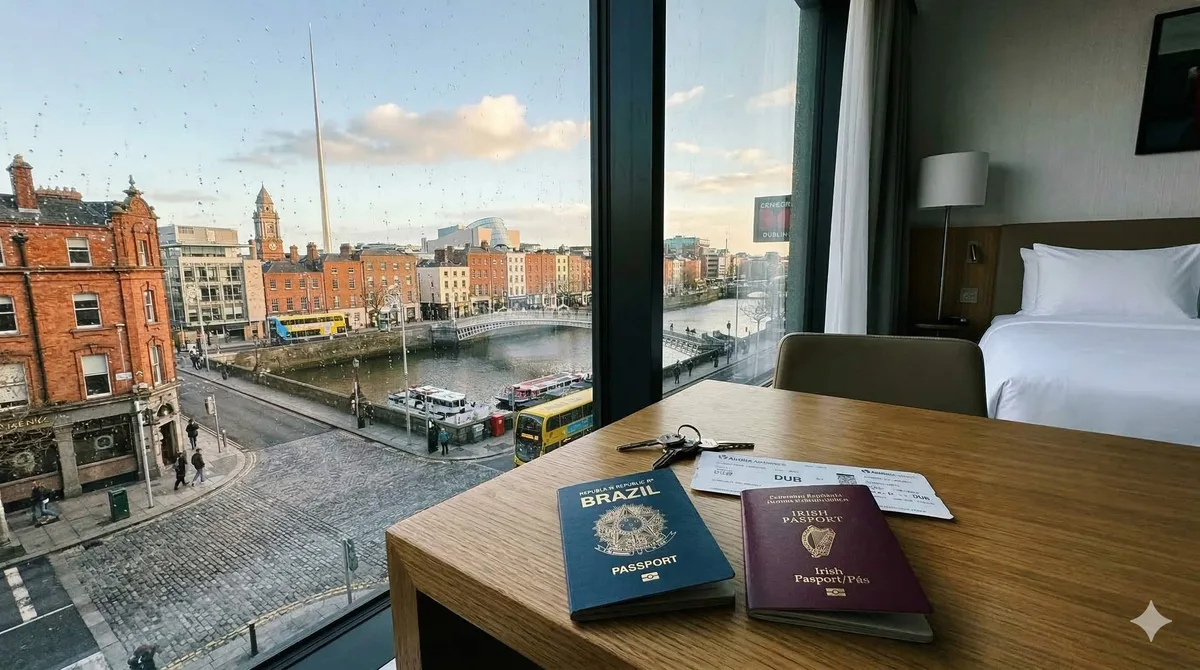
When a Brazilian decides to go on an exchange program in Ireland, the idea is usually clear: to study English, work a few hours a week, live an international experience, and enjoy what the country has to offer. Ireland has become one of the most sought-after destinations precisely because it allows this combination of study and work, which helps many students to support themselves during their time in the country.
What many people do not imagine is that after a few weeks of living here, a common perception emerges among many exchange students. It is at this moment that European citizenship begins to appear in conversations. Friends comment that they work more hours, acquaintances talk about better opportunities, and gradually, it becomes clear that there is a big difference between being in Ireland as a student and being here as a European citizen.
Total Freedom to Work
In practice, this difference starts with the job market. The exchange student arrives with a student visa and can work up to twenty hours a week during the academic period. During academic holidays, this limit rises to forty hours. This already helps a lot and is precisely what makes Ireland such an attractive destination for international students. However, there is a clear limit for those who want to advance professionally faster.
Those who possess European citizenship do not have this restriction. They can work full-time from the first day in the country, seek jobs in different areas, and even change jobs with much more freedom. Many companies also prefer to hire people who do not depend on a visa, precisely because this brings more stability to the employer. In practice, this ends up opening doors that sometimes do not appear for those who are only on a student visa.
Real Possibilities of Entrepreneurship
Another point that changes a lot is the possibility of entrepreneurship. During the exchange program, most people are focused on studying English, working a few hours, and living an international experience. Those who possess European citizenship can look at the country in a broader way, including thinking about creating their own business.
Opening a company, registering a professional activity, or working as a freelancer becomes much simpler when there is no limitation linked to the type of visa. This explains why many Brazilians with citizenship end up creating small businesses aimed at their own international community. In cities with a large presence of foreign students, such as Cork or Dublin, it is not uncommon to find Brazilians who have opened cafes, cleaning services, support agencies for exchange students, or even digital projects aimed at those arriving in the country.
Mobility Throughout Europe
There is also a benefit that often goes unnoticed at first but makes a huge difference over time. A European citizen can live and work in any country of the European Union.
This means that someone can start their international life in Ireland and, in the future, decide to live in Spain, Germany, the Netherlands, or any other country in the bloc without having to go through new visa processes.
This freedom of movement greatly expands career and lifestyle possibilities. Some people start in Ireland to learn English, then find professional opportunities in other European countries, and end up building completely different trajectories than they imagined at the beginning of the exchange program.
The Difference in Studying English
Even the way of studying changes when a person has European citizenship. Many Brazilians arrive in Ireland enrolled in English courses that are part of the visa process. These courses require minimum attendance, continuous enrollment, and periodic renewal so that the student maintains their migratory status.
Those who have European citizenship do not depend on a course to stay in the country. This allows them to study English in a much more strategic way. The person can choose an intensive course for a few months, study part-time while working full-time, or even decide to invest in technical and university courses. Studying stops being an obligation linked to the visa and becomes a personal choice for development.
Long-Term Planning
Another aspect that changes completely is the way of planning the future. Many exchange students live in cycles of course and visa renewal, evaluating each year what the next steps will be.
Those who have European citizenship can think about the long term with much more peace of mind. This includes building a career, changing cities, doing a graduation, starting a business, or even buying a property.
It is precisely when these differences begin to appear in daily life that many Brazilians start to wonder if they have the right to European citizenship. This happens because a large part of families in Brazil have Italian, Portuguese, or Spanish origins. In many cases, the right exists, but the documents that prove this descent are scattered among old civil records, churches, or historical archives.
Where to Start Investigating Citizenship
Therefore, the first step is almost always to investigate one's own family history. Locating certificates, understanding the line of descent, and verifying if there is a solid documentary basis for a citizenship process can reveal possibilities that many people did not even imagine they had.
The experience of the exchange program often opens people's eyes to these opportunities. Living in Ireland makes many Brazilians realize, in practice, how much European citizenship can expand professional and personal paths within Europe.
Irish Compass was born to help exchange students and new residents better understand these possibilities. In addition to guiding the first steps in Ireland, the platform also has a team specialized in carrying out genealogical searches to locate certificates and documents that can indicate if there is a solid basis for the recognition of European citizenship.